Art, Design & Madness
the creative branch of MAD


Art, Design & Madness (ADM) brings science, art, and design together—one space at a time—to explore how we might live, build, and imagine in ways that makes more sense for the future.
After nearly a decade working in extreme environments, labs, protests, boards, and makeshift studios - we wanted to bring together some of the people, ideas, and materials that have shaped us, challenged us, kept us going. To share them—honestly, messily, generously.
We draw from street hacks, craftmanship, deep tech, grandma’s wisdom, and wild nature. Friends from London to New York, Stockholm to Barcelona and beyond meet here—side by side with new voices. It’s a space for big questions and tanigble steps. For reimagining not just how we live—but how we want to.
ADM is part exhibition, part experiment, part home. It’s also part shop, part material library, part building story. A place where you might find your new favorite piece, meet future collaborators—or simply leave with an idea you didn’t expect.
the Designs, Materials, Rooms & Projects -
with the partners & friends who made them possible >>


meet the makers, explore the designs


more designs to come...

materials that matter
and the methods that shape them

bioplastics
ABOUT: Algae and biowaste can be used to create bioplastics—flexible, moldable materials that biodegrade naturally. These plastics are often made with just a few ingredients: algae-based starch or gelatin, water, and natural glycerin. They can replace oil-based plastics in packaging, disposable goods, and even experimental textiles. Because they break down quickly and are made from renewable sources, they offer a cleaner, gentler footprint. Bioplastics like these are part of a growing shift from fossil-based to food-based materials—designing with nature, not against it.
APPLIED: in the kitchen, livingroom and bedrooms

bacteria
biocomposite
ABOUT: Certain bacteria can “grow” materials by producing cellulose, binding fibers, or even forming biofilms that harden into usable shapes. When combined with natural elements like plant fibers or food waste, they become biocomposites—fully biodegradable and often grown with zero waste. Designers and researchers use bacterial cultures to create leather-like textiles, packaging, lamps, and tiles. The process is low-energy, low-impact, and almost alchemical—turning microbes into material-makers. It’s a living alternative to plastics, and part of a future where we grow, not manufacture, what we use.
APPLIED: in the livingroom and kitchen
READ MORE: Blunik Studio
.webp)
egg oil
tempra
ABOUT: This is paint the old-fashioned way—with a modern twist. Made from egg yolk, linseed oil, water, and natural pigments, egg-oil tempera is completely free from plastic, solvents, and synthetic chemicals. It seeps into surfaces instead of sitting on top, creating a soft matte finish that ages beautifully over time. It’s breathable too, which means it’s especially good for wood, plaster, and older buildings where moisture regulation matters.
APPLIED: On the restored livingroom, bedroom and kitchen walls
READ MORE: OVOLIN

mineral
paint
ABOUT: Mineral paint is made from earth-friendly ingredients like chalk, water glass (a liquid mineral), and natural pigments. It contains no plastics, no harmful fumes, and no synthetic additives—just clean, breathable color. What makes it stand out is how it works: instead of just coating a surface, it bonds with it chemically. That means it doesn’t peel or fade over time—it can last for decades. It also helps your walls breathe, which is great for reducing moisture and keeping indoor air healthy. Plus, it’s certified safe and sustainable from start to finish, including Cradle to Cradle and Natureplus certifications.
APPLIED: On the back stone wall in the kitchen
READ MORE: KEIM
ABOUT: Clay-lime plaster is as natural as it gets—just clay, lime, and sand. It’s free from synthetic binders or toxins, and brings a calm, organic feel to any space. Because it’s breathable, it helps regulate humidity and prevent mold, creating a healthier indoor environment. It’s also incredibly versatile—you’ll find it on walls, floors, even furniture. Inspired by ancient techniques like Moroccan tadelakt, today’s versions are tough, long-lasting, and can be repaired easily—so they age gracefully instead of needing to be replaced.
APPLIED: Kitchen counter top
READ MORE: Creative Coatings

clay lime
plaster

valchromat
ABOUT: Valchromat is a smarter take on MDF. It’s made from recycled wood fibers and dyed all the way through, so the color is part of the material—not just painted on top. This makes it tougher and more water-resistant than regular MDF, which means it lasts longer and holds up well in kitchens, furniture, and busy spaces. Because the color runs through the board, it needs fewer chemical finishes—cutting down on waste and exposure. And it’s made using wood from responsibly managed forests with a production process that reduces emissions.
APPLIED: kitchen fronts
READ MORE: Investwood

ABOUT:
HEMP IN BIOCOMPOSITES: Hemp fibers mixed with natural resins or bioplastics create biocomposites—lightweight, durable materials used in lamps, bowls, and even car parts. These plant-based alternatives to plastic are tough, tactile, often biodegradable, and valued for their raw look and low footprint.
HEMP IN FABRIC:Hemp grows fast, uses little water, and needs no pesticides. It requires less land than cotton and yields more fiber with far less impact. The fabric is strong, breathable, mold- and UV-resistant. It softens with time, lasts for years, and breaks down naturally.
APPLIED: Biocomposite bowls, lamps and Hemp cusions
READ MORE: Blunik Studio
hemp

textiles
ABOUT:
BACTERIAL LEATHER uses microbes, eg. by fermenting kombucha cultures. Bacterial leather is a plant-free, animal-free alternative that grows in sheets of cellulose. Flexible, breathable, and fully biodegradable, it’s a glimpse into a future where we grow materials.
JUTE is a tough, fast-growing plant fiber that needs little water or chemicals. It improves soil health and is fully biodegradable.
LINNEN comes from flax, a hardy crop that grows with minimal water and no synthetic inputs. The fabric is strong, breathable, naturally antibacterial.
BAMBOO SILK is made by breaking down bamboo into soft, shiny fibers. When processed sustainably, it’s low-impact and biodegradable. Bamboo grows fast, regenerates quickly, and needs no pesticides.
ORGANIC COTTON skips the synthetic pesticides and fertilizers, using less water and healthier soil methods. It’s soft, durable, and one of the most accessible sustainable fabrics available today.
APPLIED: living room (cushions), bedroom (bedlinnen), studio (prototypes)
READ MORE: Blunkin Studio (e.g. bacterial leather), and AB Småland (organic cotton)

ABOUT:
Mycelium is the root network of fungi, grown on agricultural waste like sawdust or corn husks. In just a few days, it forms dense, durable structures—no heat, chemicals, or synthetic binders needed.
It can be shaped into packaging, acoustic panels, furniture, and even leather-like sheets. It’s naturally fire-resistant, insulating, compostable, and requires far less energy to produce than foam, plastic, or leather. Numorous companies are already scaling it as a real alternative to petroleum-based materials.
APPLIED: Studio
mycelium

cheramics
ABOUT:
TILES FROM INDUSTRIAL WASTE Some designers are transforming toxic byproducts—like metal dust or slag—into beautiful, safe ceramic tiles. Using industrial waste as raw pigment reduces environmental harm while revealing the hidden colors of pollution. These tiles don’t just cover surfaces—they tell the story of waste turned valuable. APPLIED: Kitchen wall
RECYCLED CHERAMIC TILES Crushed and reprocessed ceramic waste—from broken tiles, sinks, and sanitary ware—can be turned into entirely new tiles. This approach saves raw materials and energy, and keeps waste out of landfills. Recycled ceramics offer the same durability and performance, with the benefit of circular production. APPLIED: Bathroom walls
REUSED HISTORIC TILES Old tiles rescued from construction sites, renovations, or demolished buildings are being cleaned, catalogued, and reused. These pieces often carry historical craftsmanship and unique patina that modern tiles can’t replicate.
Reusing tiles preserves materials, reduces emissions, and adds character—each piece with its own past. APPLIED: KITCHEN FLOOR, BATHROOM FLOOR
READ MORE: Ignorance is Bliss

ABOUT:
PRINTING WITH RECYCLED FILAMENT
Leftover plastic from failed prints,
industrial scraps in glasfibre, or even
ocean waste can be shredded and turned into
new 3D printing filament. This closed-loop
approach reduces virgin plastic use and
gives waste a second life.
PRINTING WITH WOOD WASTE
Sawdust and agricultural byproducts can be turned into printable, wood-based mass. These blends are biodegradable yet solid and perfect for objects like lamps, furniture, or even house structures.
PRINTING IN CORN, ALGEA & MYCELIUM
Filaments made from corn starch (PLA), algae, or even mycelium blends are enabling prints that return safely to the earth. These bioplastics can be used for disposable goods, packaging, or even speculative design with a short life cycle.
SMART PRINTING & BIOMIMICRY
3D printing allows precise, material-efficient structures—especially when inspired by nature. Using biomimicry, we can print only where strength is needed—like branching forms, shells, or bone-like lattices.
APPLIED: Studio
READ MORE: Wohn, Willowprint, Wasp
3D prints; waste based to biomimicry
radically
reused
ABOUT:
REUSED, RECYCLED, UPCYCLED, REPURPOSED, REFURBISHED
Across the project we've sought to reduce negative impact by reducing the amount of virgin materials bought; A journey from street rescue pieces to vintage chandeliers. Some pieces also combines beneath methods; like bowls reusing and recycling food waste into an upcycled design statement.
REUSED: Using something again for the same or a different purpose without major alteration. Example: Most storage in the Studio is using old wooden and plastic boxes thats been gifted from nearby resturants and stores that otherwise would be thrown away. The bathroom sinc is a recovered fountain piece from a mansion outside of Barcelona.
RECYCLED: Breaking down waste materials and converting them into raw materials to make new products. Example: The Studio has prototypes of both recycled plastics and fabrics, that can be used to e.g. create furniture, speculative design or art with.
UPCYCLED: Reusing materials in a way that gives them a higher value than the original. Example: The century old street rescue door (one in a pair, covered in graffiti); used as sofa bench and studio desk. The papermass made of cardboard coating repaired rescue chairs is another example.
REPURPOSED: Using something for a new function/changing its use. Example: Using cut-off pieces from kitchen fronts into the sofa construction. Pieces of old skatebord ramps and broken travertin tables as cutting boards and plates. Recycled textile fibres and bioplasts colored in food waste creates speculative designs in the Studio.
RESTORED: Repairing and cleaning a used product to restore it to good working condition. Example: The furniture in the apartment are nearly exclusively restored street rescue pieces or second hand/vintage designs that we've repaired and restored. From chairs to chandeliers. There is also a massive work thats gone into refurbishing and restoring original parts of the apartment, like the +500 kg heavy marble sink in the kitchen, the old balcony doors, and floor tiles hidden under layers of sand and soil.

reused,
recycled,
upcycled,
repurposed,
restored

rooms &
spaces
mineral paint

kitchen
Walls in mineral paint and egg-oil tempera, a clay-lime countertop, fronts in organically dyed wood fiber, bowls made from biological materials, and tiles tinted with industrial waste.

.jpg)


_edited_edited.jpg)
.jpg)
livingroom
Walls painted in egg-oil tempera, textiles made from hemp, vegetable silk, jute, linen, bacterial leather, and mycelium. The sofa is built from recycled TV benches and cut-offs from the kitchen build.


.jpg)
.jpg)


bedrooms
Walls treated with egg-oil tempera, built in clay lime shelves, textiles in organic cotton, and furniture sculpted from paper pulp.


bathroom
Ceiling vaults and beams reclaimed. Tiles made from recycled ceramics and salvaged from nearby construction sites. Standard glass shower doors replaced with water-treated, recycled cotton. An old terrace fountain reimagined as a tranquil sink.


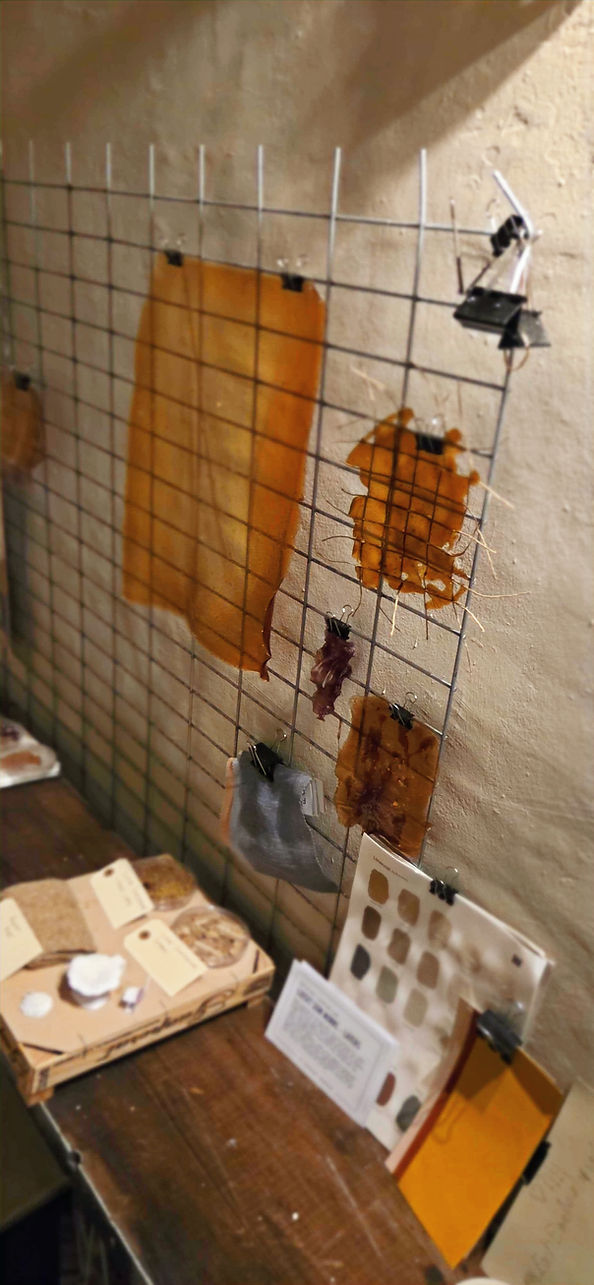


Studio
Prototypes, samples, and experiments—
side by side in process and play


the people
& projects
From installing water and electricity to precision-cutting shapes, blending pigments, and restoring rescued pieces—if you’re building something in Barcelona, these are the people you want on your team.

Water, Heat & Power- from the ground up
As the old gas-driven water pipes came out, they revealed the first glimpses of the century-old floors beneath!
Though it’s rarely seen or celebrated in photos, a huge part of the renovation has reshaped how the space runs—quietly but radically. No more water leaks. No more 14 (ho ho Christmas) or 34 degrees (sweaty summers) inside. No more power cuts.
Out went the old gas, rusty pipes, radiators, and energy-hungry heaters. In their place: a new semi-modular water, energy and heating system, fully electric, adaptable to climate conditions and various uses.
The wiring was reviewed and upgraded where needed to support efficient appliances. Most appliances sourced second-hand but never used, salvaging them from going to waste.
Jordi has supported us in early mornings and late nights through the kitchen and bathroom renovations, as well as rethinking the underlying infrastructure. With his help, every drop and whatt now works smarter, not harder.
Jordi

Dismantling the old kitchen slowly, keeping what could be given a second life

Getting the new pipes and electricity in place

Orchestrating deliveries and projects—seeking to make it all come together

Woodpecker
Behind every smooth surface and tight corner, there’s been a mess of sawdust, off-cuts, and after-hours problem-solving. Woodpecker has been at the heart of it all.
They’ve tailor-cut every piece of the kitchen—more parts than we can count—and opened up their studio to help us restore and reshape salvaged wood, mirros and glass into fronts, doors, and final details. Their machines handled what our hands couldn’t: slicing thick boards, precision-fitting odd angles, even cutting street rescue glass pieces to bring light into dark corners.
We borrowed tools, learned tricks, and lugged more panels over cobblestones than we care to remember. Their incredible generosity—the gear, the scrap pieces, the time and sharing of experience —helped us turn rough raw material into tailored craftsmanship, vibrant shapes and thriving spaces.
Wood, Tools & Craftmanship


Old wardrobe doors, gently reshaped and into solid double doors for the bathroom

_edited.jpg)
The storage of beautiful cut-offs—more often than not, the puzzle pieces that saved the day and brought our projects full circle
Layers, Pigments,
Patience & Restoration
This wasn’t just painting walls—it was peeling them back. Layer by layer, square centimeter by square centimeter. Every surfaced touched ten, twenty times. Not to erase the past, but to be in dialogue with it - bringing it back today.
Original pigments reappeared beneath decades of layers —guiding us toward colors that belonged to the space. Windows, doors, beams and vaults restored - not replaced. Tiles scrubbed and waxed until the stories of those who've walked the rooms before us shone through.
A consious work of removing only what was broken or blocking the space from breathing. This is restoration, not renovation. A patient rebuilding rooted in the tools, textures, and techniques from the neighborhood, and those who walked these streets before us.

Once the layers above the original floors came off, the real work began—restoring the damaged structures beneath

Carefully peeling damaged layers back

Blending, testing, and layering—until the right nuances surface


Restoring the old walls, crack by crack

The local pinturas and ferreterías—the neighborhood paint and hardware shops—helped us test, match, and bring back pigments

Rescued & Reimagined—Stories in Every Piece
Taking the opportunity to visit nearby construction sites—rescuing discarded materials and learning from their ways of working
Some materials come with a past you can feel.
Historic tiles, sincs, wooden frames, pieces of stone and marble - rescued from demolition sites have been carefully cleaned, sorted, and returned to use. Each one carrying the marks of time, wear, and craft no factory can replicate. Placing them back into their new home, is like assembling a quiet archive, decoding and writing a new chapter with old stories intertwined. Honoring the past while building something new.
The story grows richer with the rescue pieces from the streets—discarded objects given a second life through experimentation. A broken door becomes a table. A bent metal bar becomes a drying rack for bioplastics. Chairs are repaired and reimagined. Frames are filled with new work. Some pieces stay. Others, in better condition than when found, are gifted back to neighbors.
This is reuse, rebirth, as dialogue—testing, listening, responding. Watching how the old and new interact. Peeling back what doesn’t belong to reveal what does. And then dressing the space not just to look good—but to reflect what it’s made of, where it comes from, and where it’s going. Every object, every surface, is part of that evolving conversation.

The team at Oranto – Elementos de Arquitectura Antigua – does incredible work recovering and restoring pieces from old building reconstructions. Their expertise and experience have been invaluable throughout this process.

Removing tiles laid over the original foundation by hand—carefully carving out the base to save any remaining pieces, let the structure breathe, and create a solid ground for the newly recovered tiles to rest on.
>> Restored tiles, fountains, and more—reused and rehomed
_edited.jpg)
Each recovered tile set by hand, slowly rebuilding the patterns that once were.
_edited.jpg)
Exploring how restored and recovered tiles come together—creating a rich, renewed base from the past and present.

The rooms are being restored from the bottom up, one by one—letting the underlying layers breathe before building them back stronger. Here, the floor tiles start to settle in as the wall layers dry around them.

Installing the old terrace fountain as a small sink in the bathroom—giving it a new purpose and setting.

Testing layers around the tiles, while carefully restoring the damaged surfaces of the beams above.

Turning old wardrobe doors into bathroom doubles—thanks to many daily walks (and laughs) with the local carpinteria.

A continuous process of recovering pieces from the street—testing and prototyping how they, and the studio itself, can enter a reimagined dialogue that moves us forward, step by step.
_edited_edited_jp.jpg)
A look into Oranto’s stunning archive of restored tiles—each one carrying a piece of architectural history.

Aubert—the local, family-and-friends-run ferretería. A neighborhood building store that’s backed us with the tools, materials, and know-how to tackle just about anything.

Black and White is a powerful anti-racist movement that hosts pop-up secondhand markets—where we’ve found everything from our chandelier to books, cutlery, and ceramics.

Oranto’s remarkable collection of recovered vintage and antique architectural elements—a true treasure trove.
>> From street-rescued pieces to vintage stores, the local ferretería, anti-racist pop-up markets, and that often-overlooked corner of the studio
(aka where we find stuff)

>> Turning waste into resource
—glimpses of a sofa built from old TV benches, kitchen offcuts, and leftover wardrobe parts.gimples of building a sofa from old TV benches, kitchen cut-offs and left over wardrobe parts)

The first sofa prototype: a rescued street door, gifted fruit boxes, and a test of scale and structure.
Building the sofa piece by piece—testing how each part fits, and adding cut-offs from other projects to let the full shape take form.


Drilling the base structure into place—laying down a solid foundation and frame to build from.
Beginning to integrate the sofa into the wall—using the same materials we restored the walls with, bringing it all into one continuous form.
Adding mattresses and plants from two neighboring shops, mixed with prototype materials, street rescues, and bioplastic lamps—
and tada! A 5-meter sofa, complete with enough cushions to fill the floor for home cinema nights and long conversations.


Each tile carries its own expression, tinted by metal waste pigments. Testing how they align, contrast, and connect.
As the appliances and kitchen structure take shape, we begin layering the countertop with clay-lime plaster. Behind it, the recovered stone wall gets a fresh breath—treated with mineral paint to preserve its texture and story.
Every valchromat front—its fibers individually dyed with organic pigments—has been tailor-cut multiple times to fit each niche and nook. Using offcut pieces to finetune the frames, enabling the last milimeter precision.
>> a Mosaic of Materials
(a deep dive into the kitchen)

_edited.jpg)


Mixing strips of cardboard from deliveries with surplus water and flour bought at the market across the street. Testing consistencies, gently layering and shaping—exploring how a rescued street chair can be wrapped and reinforced with care.
While the chair dries, the sharp edges of a rescued mirror are carefully cut down—one detail at a time.

A close up on the fibres and structures
>> breathing new life into street rescue pieces
(a closer look at a paper pulp chair)

Settling in.
partners & friends